

How NIH Investment Fuels the American Economy
Most people know the National Institutes of Health (NIH) for the life-saving science it funds. Fewer realize it’s also a major economic engine for communities across the country. When a university lab in Ohio or an academic health system in Texas receives an NIH grant, that money pays salaries, buys equipment, and keeps facilities running. The benefits ripple outward, sustaining local businesses and workers, many of whom might never step foot in a research lab.
The NIH Funding Economic Impact Report by United for Medical Research (UMR) analyzes the link between NIH funding and the economy and is sponsored in part by the AAMC. We contribute to this work because the data tell a story that deserves to be heard.
In 2025, the NIH distributed $36.58 billion in research grants to organizations in all 50 states, keeping more than 390,000 people employed and generating over $94 billion in economic activity nationwide. That means that every dollar invested in NIH-funded research returned about $2.50 to the broader economy — a 250% return on investment.
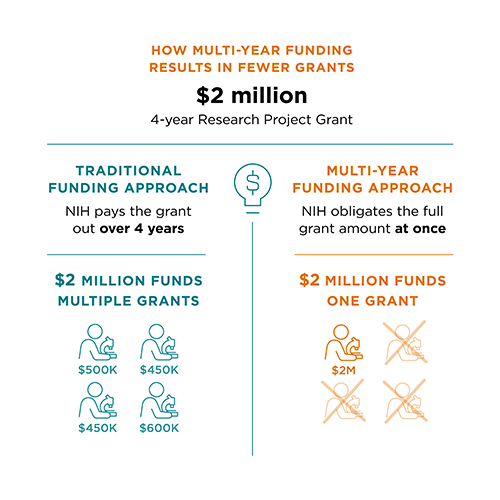
Last year also brought an important lesson about how NIH funding flows. Administrative disruptions slowed awards early in the year, and to meet its spending deadline, the NIH obligated multi-year grants up front rather than in annual installments. While the full appropriation was spent, this approach concentrated funding in fewer, larger awards rather than distributing it across the research community.
This had a knock-on effect: nearly 5,600 fewer grants were made than in 2024, and the share of applicants who received funding fell to the lowest percentage (17%) in almost three decades. Nearly half of states saw double-digit declines in funding, which meant fewer jobs and missed research opportunities.
Congress took notice. The FY2026 funding bill includes explicit guardrails on the rushed spending practice, reflecting a bipartisan commitment to ensuring NIH funds reach as many researchers and communities as possible moving forward.
The new guardrails from Congress are built on decades of remarkable returns.
Over the last 10 years, sustained NIH funding has generated more than $822 billion in economic activity, supported more than 3.7 million jobs, and helped the U.S. maintain global leadership in science and medicine. As China and other nations accelerate their own research investments, that leadership is not guaranteed. A strong NIH is essential to our nation’s long-term competitiveness.
The AAMC cosponsors the UMR report because good decisions require good information. In addition to advancing life-saving science, the NIH is an engine of economic growth — supporting hundreds of thousands of jobs, generating billions in economic activity, and strengthening national prosperity.
We all benefit from a strong, consistently funded NIH. As Senator Susan Collins, Chair of the Senate Appropriations Committee, put it: “There is no investment more worthwhile than our nation’s investment in biomedical research.”
The AAMC remains committed to #KeepNIHStrong. Read the full UMR report and take action to support sustained NIH funding.